
Scott Ramsay visited Tawana, in Botswana’s iconic Moremi Game Reserve, in April 2026 to witness the positive impact that regenerative tourism can have on a critical conservation area.
It was the beginning of another normal day at Tawana Lodge in the Okavango Delta. I’d woken early and watched the last of the stars fade away. After a coffee and freshly-baked muffin at the campfire, my guide Jonas Kamere picked me up in a Land Cruiser. As the sun rose we headed into the wilderness.
The Gomoti River floodplain was looking spectacular after a big rainy season.
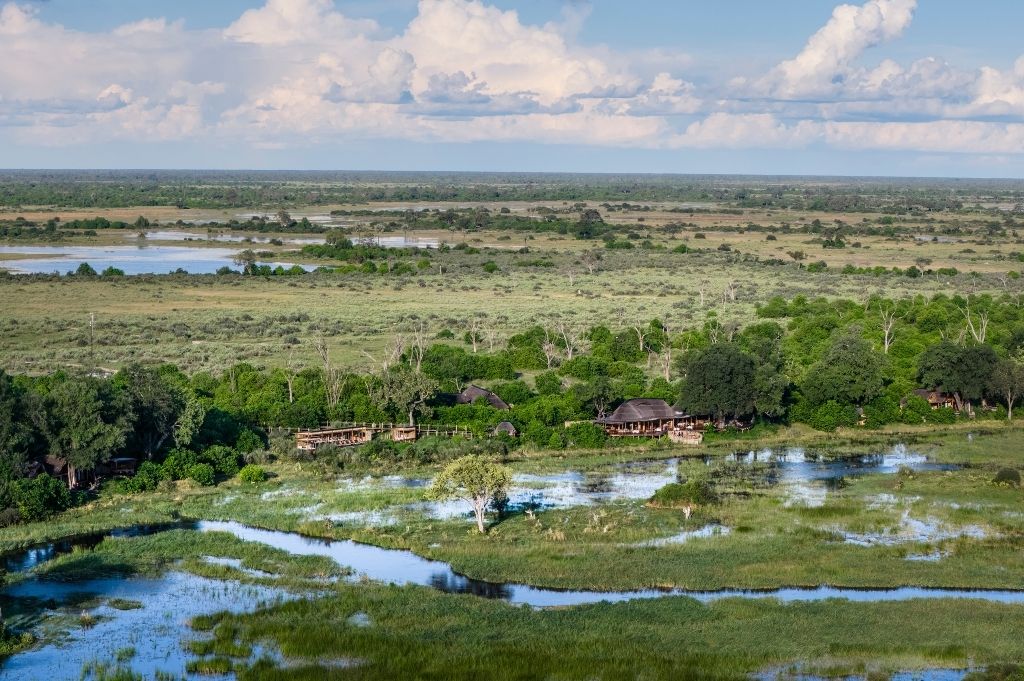
A few bull elephants wandered past, and impala herds were brimming with playful youngsters. Kudus with spiraling horns stopped and looked at us intently. Red lechwe grazed on the fringes of the swamps.
Hippos lazed about like big fat pork sausages, and jacanas hopped along the lily flowers. Flocks of white-faced ducks and spurwing geese whistled and cackled through the sky.
As Jonas drove me around, the vitality of this abundantly wild land seemed to infuse every cell of my body. I felt like I was high on drugs. Healthy, happy drugs.
Back at Tawana, I ate brunch, then walked along the raised boardwalk to my luxurious room, perched on wooden stilts above the floodplain. I heard squirrels screeching in the trees, so instinctively I looked around.
Leopard! Judging from her size, probably a young adult female. She looked at me briefly and ambled unfazed through the bushes, heading under the wooden floor of my room, perhaps to spend the heat of the day in the shade.
And so it was that I came to take an afternoon nap next to a languorous lady with a beautiful fur coat and seductive amber eyes.
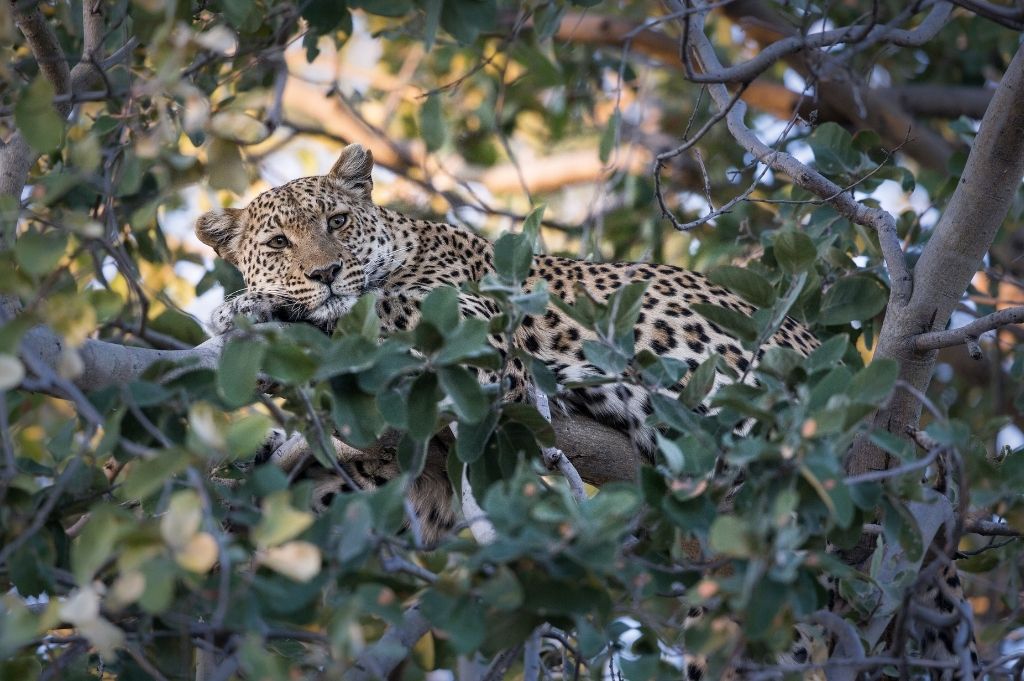
Later, Jonas told me that the young female leopard is regularly seen in camp, and seems to be making Tawana her home.
For most tourists, it’s momentous to see a leopard somewhere – anywhere! – in Africa. What about a leopard taking up residence under your sprawling bedroom suite on the edge of a magnificent floodplain?
Botswana’s 25 000 square kilometer Okavango Delta is rightly famous as one of the world’s natural wonders. This vast inland water world in the Kalahari rivals the Serengeti or Zambezi Valley for grandeur, drawing thousands of high-paying tourists annually.
To be here, on the edge of the Gomoti River, is to know an African valhalla. It’s an astonishing wild place that stands out as a shining beacon of poetic nature in an increasingly mechanised and digitised human world.
But the Okavango is also a vital contributor to Botswana’s GDP. The tremendous wildlife and stunning scenery makes it economically valuable to the country. The luxury safari business in the country is booming, and new camps are opening up every year.
Safari tourism contributes about 15% of the country’s revenue, second after its famed diamond industry. About 150 camps and lodges in the Delta employ thousands of people, and many times that number indirectly. Tourism is by far the biggest industry in Ngamiland, where there is almost no other formal employment.
And it’s all thanks to the wild animals, especially the flagship species.
“Everyone wants to see a leopard, lion or wild dog,” Jonas laughed. “Who doesn’t!”
In most wild places of Africa, these predators are declining in number. But here, in the Delta, their numbers are as healthy as ever. There are only about 6 500 wild dogs in Africa, but Botswana has 800 of them, as well as an estimated 3 500 lions, of which there are fewer than 25 000 on the continent.
“Our wild dog population is one of the few stable ones in Africa,” explained Dr. David Hoffman, a zoologist at Botswana Predator Conservation, a non-profit research organisation working in Moremi Game Reserve since the late 1980s.
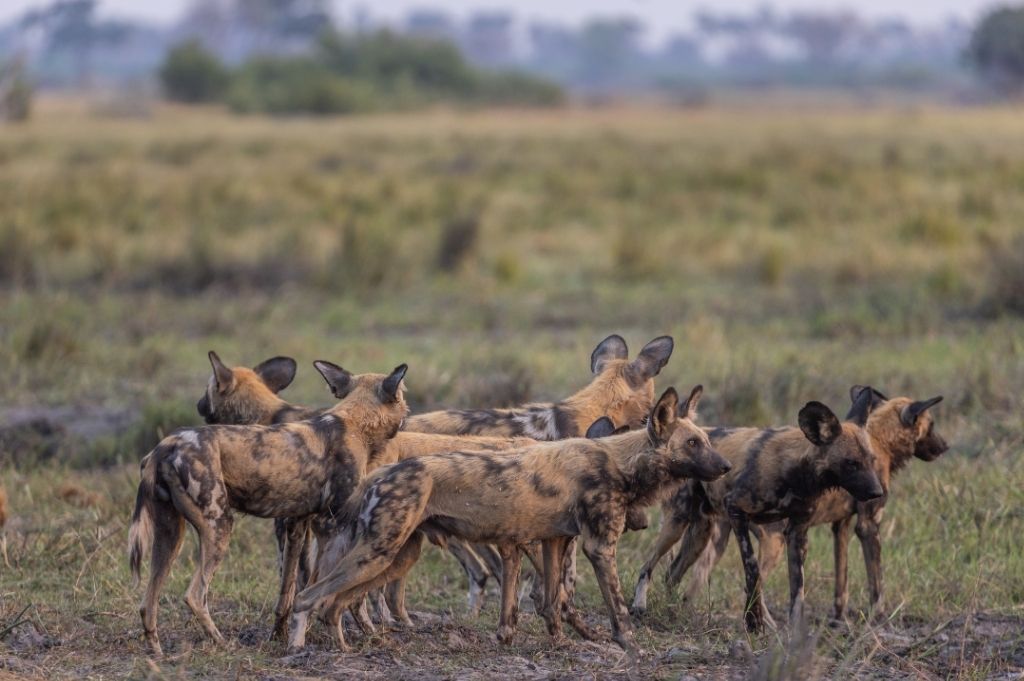
“In most ecosystems, wild dog numbers are plummeting, because of human expansion,” David told me. “The species has been eliminated from 95% of its former range in Africa. The Delta is one of the few remaining ecosystems on the continent that is still mostly pristine.”
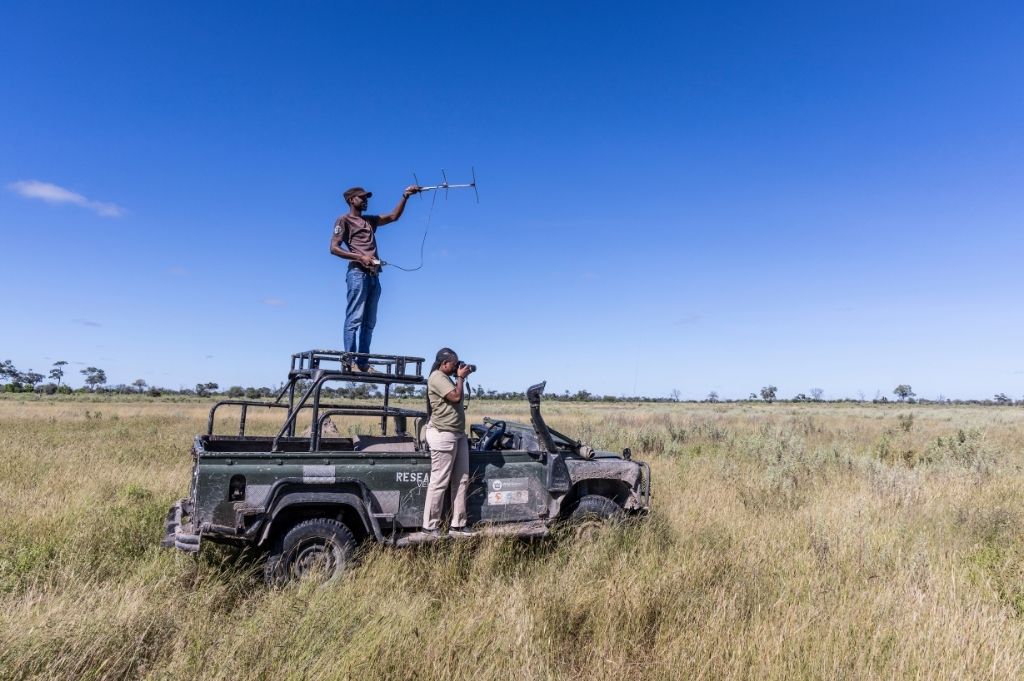
Based a few kilometres from Tawana, David and the BPC team at “Dog Camp” study the demographics, behaviours and movements of Moremi’s predators. Their intensive research, among other purposes, helps inform the Botswana government, which rely on BPC’s scientific data when they need to make conservation management decisions.
Tawana Camp’s owners Natural Selection has sponsored BPC for several years, via the company’s non-profit foundation. For every booking from every guest that stays at Tawana, 1,5 percent of the total booking fee is donated directly to BPC. Additionally, every guest at Tawana pays a conservation levy that goes directly to BPC’s research.
While tourists pay several thousand dollars per night to stay at an exclusive lodge in the Delta, most of the local Hambukushu and Bayei people still live in comparative poverty. Much of their wealth lies in their livestock: cattle, goats, horses and donkeys.
A single goat is worth about 1 000 Pula (US$70). For a local, that’s a significant amount of cash in a country where the minimum wage is around 10 Pula per hour (about US$0,70 cents).
Predators like lions, leopards, wild dogs, jackals, hyenas and caracals kill several hundred livestock animals every year. Although no comprehensive formal studies have been done on stock losses for the Delta as a whole, various smaller studies suggest that stock losses run into millions of pula. Retaliatory killings of predators are regular occurrences, as locals seek to eliminate the threat to their livestock.
Camps like Tawana can charge premium prices precisely because their guests have a near-guaranteed chance of seeing a leopard, lion or wild dog. Local shepherds, however, would obviously prefer if there were far fewer predators around – or if the predators would at least stop killing their livestock.
And so to help the livestock farmers, BPC has worked for 20 years to come up with various solutions to prevent livestock from being attacked.
One of the most effective programs it the use of animal scent to deter predators. To find out more, I flew back to Maun, to see Dr. Peter Apps, who heads up BPC’s bio-boundary project at their laboratory.
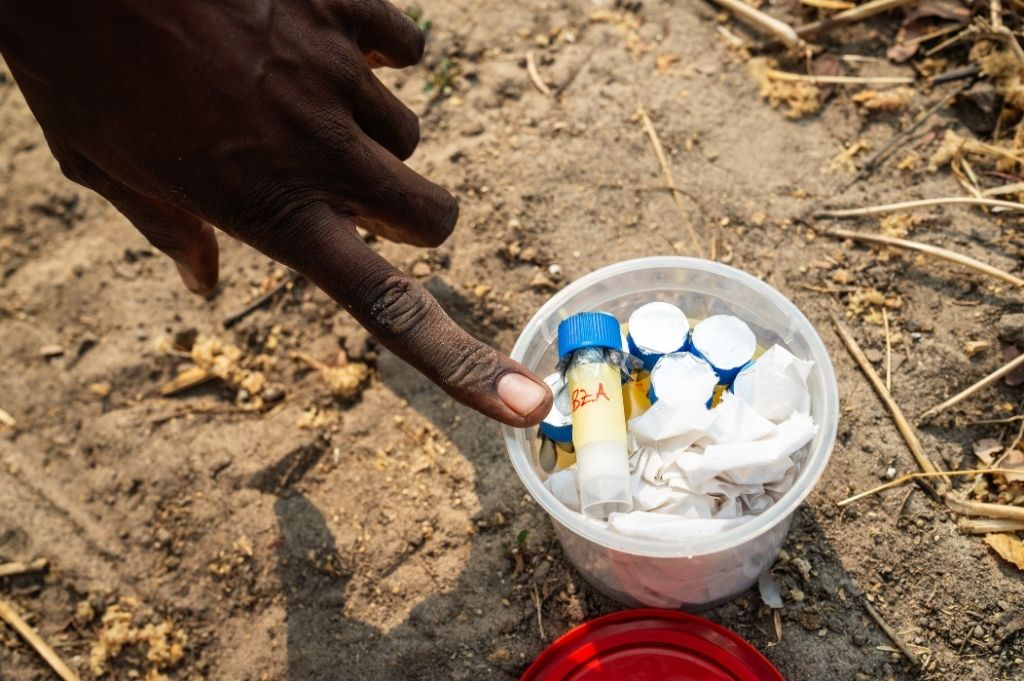
With a Masters from Oxford and a Doctorate from University of Pretoria, Peter’s expertise in both zoology and chemistry have given him a unique understanding of how animals use scent to communicate.
Peter was hired in 2008 by BPC founder Tico McNutt to head up a unique, world-first scent bio-boundary project.
The American zoologist McNutt – based in Botswana since 1989 – had first realised the potential of using animal scent in 1996. At the time, four of the ten packs of wild dogs he was studying in Moremi had died of rabies, yet the vacant territories weren’t infiltrated by the surviving adjacent packs for many months. Something had kept them out. It was the long-lasting wild dog scent markings.
“Through their scent markings, wild dogs are basically telling the other pack: you stay there, we’ll stay here,” Peter explained. “It’s effectively a fence between two neighbours. Venture further at your own risk.”
Every species leaves a different scent mark, as does every individual in each pack. There are hundreds of different chemical substances in a millimetre of urine, but they have to be isolated with a mass spectrometer, and then each one needs to be analysed and tested in the field to see if it’s an effective deterrent.
“It takes more than a few hours,” Peter chuckled. Indeed, he has worked at the vast conundrum for almost 20 years.
“Animal scent is a hugely difficult field of study,” Peter said. “There are no other databases on this stuff. Almost all animal scent studies were done on captive or domestic animals. As far as I know, our study is the only one that focuses on wild animals in Africa.”
Despite this, Peter has had notable successes over the years. For instance, he’s discovered several deterrents to stop elephants from raiding crops, by using certain plant species that elephants find repulsive.
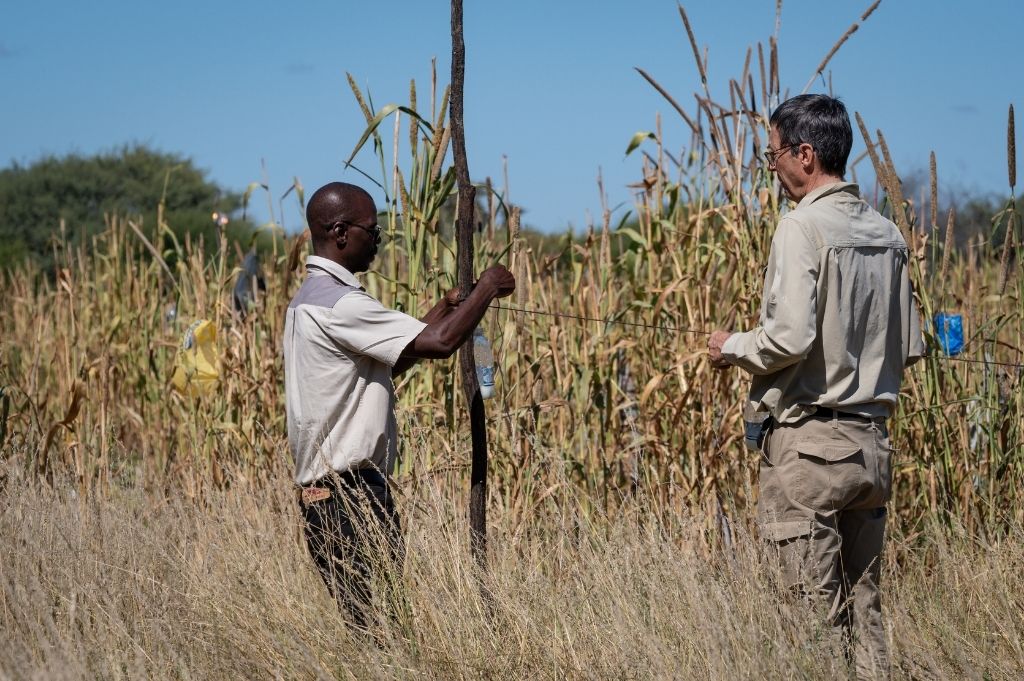
“We put the elephant repellent around ten little fields and used the farmers’ closest neighbours as a control with no repellent,” Peter told me. “The farmers harvested all the repellent fields and the elephants harvested all the controls. That’s been a huge success.”
Peter has also had success with leopards. He was able to figure out a compound that stopped leopards in their tracks. Turns out, it happened to be the same chemical that’s also found in domestic tomcat urine.
“It’s called 3-Mercapto-3-Methylbutanol, and it’s found in tomcat urine!” Peter laughed. “It had been identified already, that’s why it’s in the research database, and I could match it to the leopard urine.”
Bizarrely, the same compound is used as an aroma in some foods and coffee – even in perfumes. So a synthetic version of it was readily available from a chemical producer in Germany.
Peter bought a few bottles, and made a prototype collar with a small plastic tube that held a sachet of the 3M3MB compound. He handed out his new invention to a few local farmers to test it on their livestock herds. Peter has conducted more than 20 trials with subsistence livestock.
“The leopards don’t come close to any of them, which is unique for all of these kinds of interventions. Some of the farmers were losing two or three goats a week, and the predation stopped immediately.”
And the collar invention costs just a few pula, so it’s affordable to even the poorest livestock farmers.
As I was chatting to Peter, someone knocked on his office door. It was Othata Dikobe, and he’s a farmer from south of the Delta, in the Hainaveldt area. His farm is 64 square kilometres in size, and he’s got about 200 cattle, 100 goats, and 70 sheep.
He’d come to visit Peter to buy some more collars for his goats, which were being heavily predated by leopards.
“In two months at the end of last year, I lost 38 goats to leopards,” Othata told us. He then fitted 14 collars on his herd in the new year. “Since then, I’ve lost none. That’s why I’m back buying more collars.”
What about wild dogs, I asked Peter.
“Scientific studies have proven that wild dogs kill only a small fraction of livestock in the Delta. Lions, leopards, black-backed jackals and spotted hyenas are the main culprits, but wild dogs often get blamed.”
Peter explained to me that a lion will kill and eat a goat in the night, then disappear, leaving the carcass. But the next morning the farmer may happen to see wild dogs in the area, and assume the canids killed his goat. And because wild dogs are usually unafraid of humans, and don’t run away, they’re easily shot, or poisoned.
“Wild dogs are excellent at hunting and looking after puppies, but remarkably stupid when it comes to humans,” Peter said. “Farmers will find pack of wild dogs sunning themselves in a road, and shoot four of them before the other ones run away. That’s what makes them so vulnerable.”
The puzzle to keep wild dogs away from livestock is still not entirely solved but Peter is making progress. In an experiment, Peter isolated the scent compound from a lion’s mane, and it seems to be effective at stopping wild dogs in their tracks.
“It makes wild dogs do a U-turns. And that’s huge, nobody’s ever done this before.”
However, Peter is wary of rolling out this specific compound to farmers like Othata.
“Firstly, it might attract other lions. Secondly it might habituate the livestock to the smell of lions, and then when there’s a real lion they don’t react. So I’m treading carefully with this one.”
Wild dog territories are huge, and they move long distances. A dispersing pair of male or female dogs can move 400kms across Botswana, going into Hwange National Park in Zimbabwe, for instance. As long as they don’t come near humans or livestock, there’s a good chance they’ll survive.
With Peter’s bio-boundary research, he ultimately wants to find a compound that will reliably keep wild dogs away from villages or livestock grazing areas.
“We’ll give them artificial neighbours – and then they’ll be happy to stay at home. The farmer wins, and the wild dog wins. Everyone wins.”
Coaching Conservation
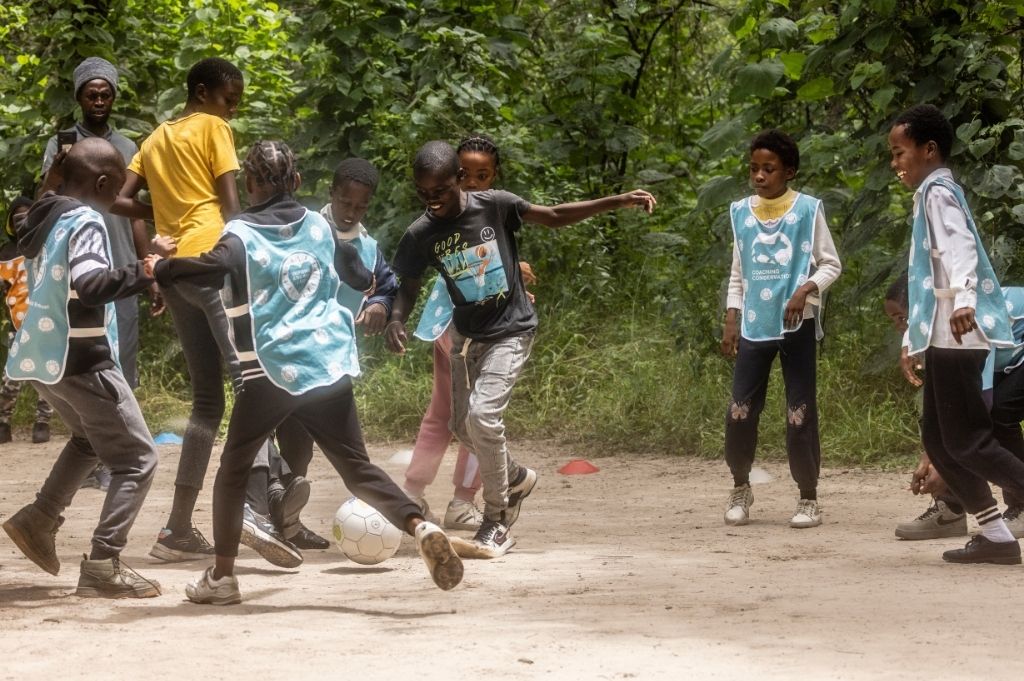
Wild Entrust also runs Coaching Conservation, a long-running, highly successful education program that uses soccer to teach children in Ngamiland about the importance of wildlife, and how wild animals can teach them about how to live a good life.
Wild Entrust’s founders Lesley and Tico McNutt started the program 20 years ago, after realising that local people weren’t responding to traditional conservation messaging. Lesley was doing her best to change the attitudes of adults, sitting with communities for days at a time.
“We asked – why aren’t they listening? Well, we were in the peak time of HIV and AIDS, so people didn’t have a great deal of faith in their own future. Asking them to care about wild animals when they don’t really necessarily have faith in their own lives was too big of an ask.”
So Lesley changed her focus from adults to kids. In 2004, she started a soccer team called the Wild Dogs, for the kids in Shorobe.
“When you support things which the community value, then there’s a more likely chance they’ll support what you value.”
Lesley linked the game of soccer to the wild animals living alongside the villages.
“Through playing soccer, we taught kids to mimic the behaviour of certain animals on the soccer field. So for example, they learned about the cheetah, and what makes them successful is speed, balance, and agility. They learn about fast dribbling and acceleration. When you use that skill in a soccer game, every time you’re thinking about running fast, you’re thinking about being the cheetah.”
Kids would then learn about the conservation challenges of each species that they were mimicking on the soccer field.
“So cheetahs eat goats, farmers shoot cheetahs. If you can corral your goats and do better animal husbandry, you can keep the cheetahs from being killed. So if kids can help manage their small stock, everybody wins. Dad doesn’t kill the cheetahs and the cheetahs survive.”
“Rhinos, for instance, teach you about change of direction quickly and defending your territory. If you’re in a bad friendship group, just change. As another example, lions teach us about mastering the ball and being confident and full of strength.”
Coaching for Conservation employs four full time coaches, who spend most days of the year travelling to 93 schools in villages, including Khwai, Sankuyo, Shirobe, Shakawe, Etsha, Moreamaoto and Gweta.
It’s a comprehensive program in a region of 130 000 square kilometres, reaching 16 000 kids every year, aged 10 to 12 in grades 5, 6 and 7. “Our aim is maximum saturation, minimal dilution,” Lesely said.
Natural Selection Foundation sponsor the entire costs of the Grade 5 program, whose totem animal is the wild dog.
“Wild dogs are all about team work. They teach us how to collaborate, be kind, take care of your siblings, take care of each other. So in every soccer lesson there’s a life lesson.”
Boys and girls play together.
“At that age, everybody can play together. It’s really important that girls and boys play together because it changes gender relationships when they’re older. We always say we empower girls by empowering boys and girls together.”
Additionally, every one of the 16 000 kids are taken on a game drive once a year. Natural Selection ensure that vehicles and guides are made available to Lesley and her team, to give almost every kid in Ngamiland a chance to see the animals they’re learning about.
“These kids are often terrified of elephants, because their only experience of one is it’s either trying to kill you, or eat your crops. So these game drives give them the opportunity to engage with this amazing animal with a sense of awe, rather than fear.”
“And then they learn about elephant families, and how they’re just like us and how they take care of each other. The kids start to see that elephants need the same things in life, and that they have a right to be here too.”
Lesley’s team then follow up with each kid after the courses, to ask them about what they learnt, and how their own lives have changed.
“Our three metrics are: respect for self, respect for others, respect for the environment. Basically, what have you done to be a kid who cares? We ask them about intentions and behavior. So what are you going to do? What did you do?”
After 10 years, Wild Entrust again follows up with as many of the kids as possible.
“We ask them where they are in life, what they are doing, and what they remember from the courses. It’s extraordinary what kids remember. It’s extraordinary what individuals have done with their lives.”
Lesley’s program has been so successful, and well-received by the people of Ngamiland, that the Botswana’s ministry of education has recently approached her to roll out the program nationwide.
“They told us that what we’re doing is far more effective with kids. The way we use play-based learning to get kids excited and enthusiastic. They want us to teach Botswana’s teachers about how to implement our methods.”
For Lesley, a social anthropologist who has worked in Botswana since 1992, local people are critical to any conservation project.
“I’ve been preaching my whole lifetime that conservation is about people. You can do research till you’re blue in the face, but if you don’t care about the people, if you’re not acting to help improve the lives of people who actually live with the wild animals, then you’re not doing conservation.
Shorobe Learning Tree Pre-School
The dusty town of Shorobe lies on the main road north from Maun, into Moremi Game Reserve. Most tourists fly from Maun to the lodges in small planes, or drive the gravel road to Moremi. Yet Shorobe sees little benefit from all the passing cars and airplanes overhead.
“Shorobe is the forgotten passageway for people going from Maun to Moremi,” explained Jennifer Lalley, head of Natural Selection Foundation. “A lot of tourists drive through there, but there’s no benefit to the community. We wanted to help in some way, so we looked at what the people needed. And they told us they needed a pre-school.”
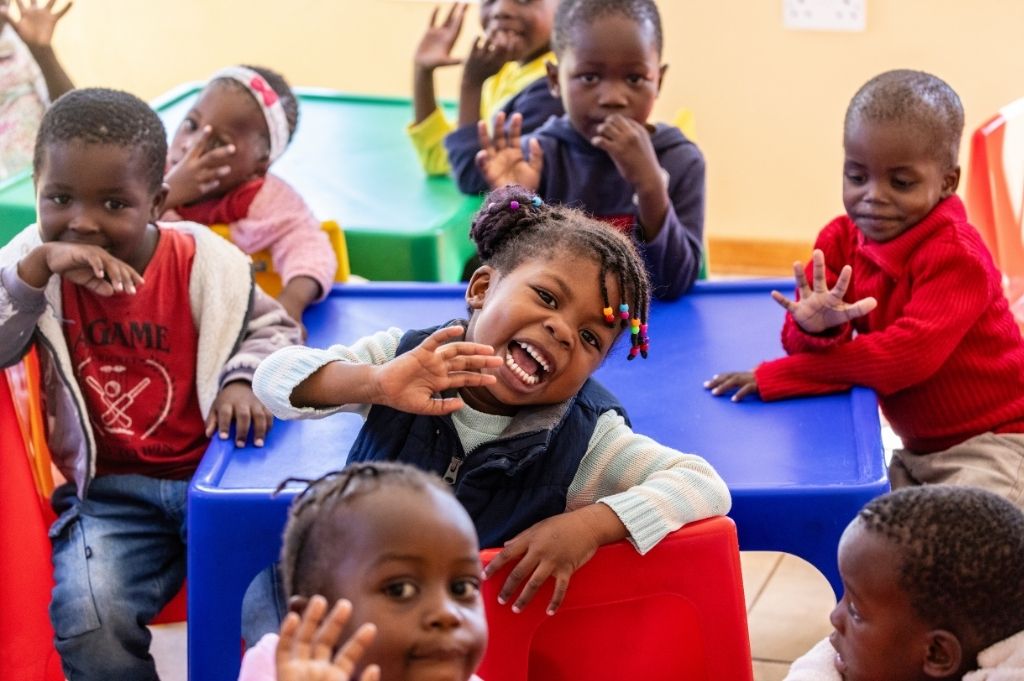
Natural Selection found an old building in the village, renovated it, painted it with baobabs, elephants and birds, and turned it into a brand-spanking new pre-school. Today, teachers Hope Sinvula and Monty Mobe teach almost 50 young kids from the village.
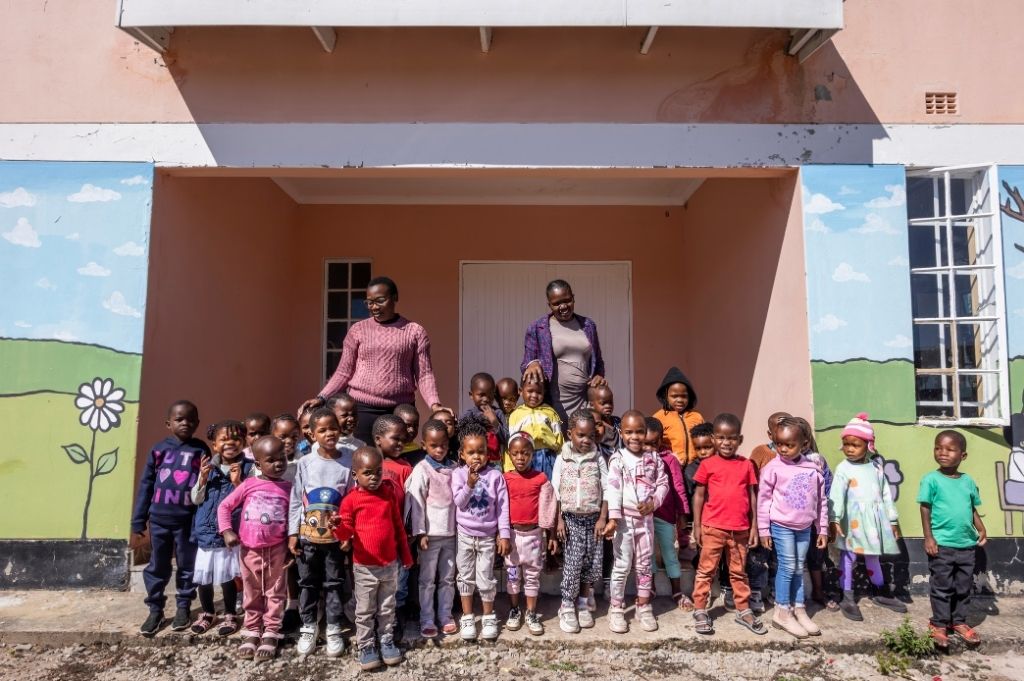
There is no formal pre-schooling in Botswana, so most children pitch up at Grade 1 at the age of 7 without any education.
“Early childhood education has never been taken seriously in Botswana,” explained Sandra Rubins, who heads up Natural Selection’s community programs.
“Young kids in Europe or South Africa can go to pre-school, but Botswanan kids start their education at Standard 1. They only have one term of pre-school. So kids go to school without even knowing how to hold a pen or crayon, or how to count to 10. So the Learning Tree gives these kids a great kick-start to their education.”
The foundation funds the teacher’s salaries, as well as breakfast and lunch for each of the kids every school day.
“Porridge in the morning, and a cooked meal at lunch, with a mixture of rice, carrots, cabbage, butternut, beetroot, samp, beans and macaroni, depending on the day. We are also going to start giving the kids red meat twice a week,” Sandra said. “This is huge for a community where kids often go hungry.
In winter, before the start of each day, each kid also gets a bread roll with peanut butter, and a cup of hot rooibos tea with sugar.
“You know how cold it gets here in winter! So this makes it much easier for the kids to concentrate in class. There’s no way you can expect a kid this age to concentrate if they’re hungry. In the past, kids would simply start crying because they were so hungry.”
Author and Photographer: Scott Ramsay
Scott is the author of Spirit of Africa and South Africa’s Wildest Places.
CLICK HERE to learn more about Tawana lodge.